
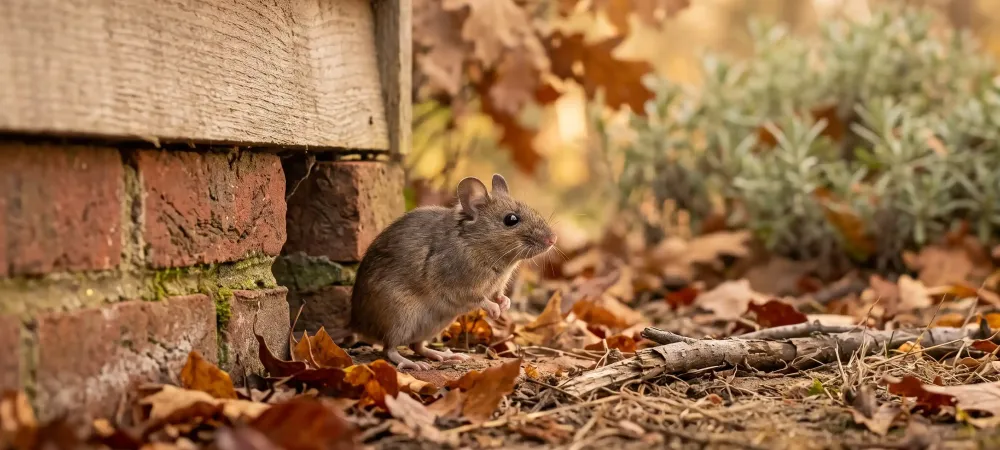
When Do Mice Come Inside? How to Keep Rodents Out of Your Kentucky Home This Fall
Mice in Kentucky begin moving indoors in early September, triggered by nighttime temperatures falling below 50°F. The entry window runs from September through October and is the highest-risk period for new infestations to start. Because a house mouse can squeeze through a gap roughly the size of a dime, most homes have multiple undetected entry points already in place. Sealing those points before mice establish interior nesting routes is significantly easier, and less disruptive, than eliminating an established colony once one takes hold.
Why September is the critical window for Kentucky homeowners
Kentucky's fall temperature pattern drives predictable mouse behavior. When nighttime lows drop consistently below 50°F, which happens across the Lexington and Louisville areas in early-to-mid September, mice that spent summer nesting in fields, mulch beds, woodpiles, and foundation perimeters begin actively searching for warmth.
This is not an annual fluke. It follows the same timeline every year. The practical difference between homeowners who deal with a mouse problem in October and those who don't is almost always whether entry points were sealed before the migration started.
The two species Kentucky Pest Control handles most commonly in Kentucky are the house mouse (Mus musculus) and the white-footed mouse (Peromyscus leucopus). Both are capable of establishing colonies inside walls, attics, and crawl spaces within days of entry. White-footed mice, which are more common in rural and suburban edges around Lexington, are also a carrier of hantavirus, making early exclusion a health matter, not just a property matter.
What actually draws mice indoors (temperature is just the trigger)
Cold is what starts mice moving, but food availability and nesting material are what make a home an actual destination rather than a brief stopover. Mice are opportunistic feeders. Pet food left out overnight, bird seed stored in paper bags, pantry staples in cardboard boxes, and crumbs at the back of a drawer are enough to sustain a colony.
Once a food source is located, mice establish regular foraging routes and mark them with scent, which is why the same paths get used night after night. Reducing those attractants as part of a fall prevention plan meaningfully cuts how appealing your home looks to mice beginning their search in September.
- Switch pantry items to airtight hard-sided containers
- Pick up pet food bowls overnight; leave nothing accessible after dark
- Move bird feeders at least 15 feet from the home's foundation
- Stack firewood on a raised rack at least 20 feet from the exterior walls
- Keep grass and vegetation trimmed close to the foundation perimeter
How mice are getting in (and why most DIY fixes don't stick)
The most common DIY failure: placing traps inside while new mice are still entering through unsealed gaps. Trapping an active population while entry points stay open is a treadmill, not a solution. The exclusion has to happen first.
According to the CDC, a house mouse can fit through any opening approximately a quarter-inch wide, roughly the diameter of a dime. Common entry points in Kentucky homes that often go undetected include:
- Gaps where plumbing or electrical lines pass through the foundation or exterior walls
- Gaps around garage door frames where weatherstripping has worn or compressed
- Foundation cracks, especially in older brick homes common to Lexington and Louisville neighborhoods
- Dryer vents and attic vents without tight-fitting, undamaged screens
- Gaps behind kitchen and bathroom cabinets where walls meet the subfloor
These openings are typically in spots homeowners don't check regularly. A professional rodent inspection at Kentucky Pest Control includes a systematic exterior and interior entry point assessment, the step most homeowners skip when trying to handle a mouse problem on their own.
Signs mice are already inside your home
Mice are nocturnal and stay hidden during the day, meaning a colony can be established for weeks before a homeowner sees one directly. Earlier indicators include:
- Small, dark, pellet-shaped droppings (3 to 6mm) concentrated near food sources and along walls
- Gnaw marks on food packaging, baseboards, or electrical wiring insulation
- Grease smears or dark smudge trails along walls where mice run consistently
- Scratching or rustling sounds inside walls or ceilings, most noticeable at night
- A faint musty or ammonia-like odor in enclosed spaces such as cabinets, closets, or crawl spaces
Finding a single dropping in the pantry or a gnaw mark on a bag of pet food is not a minor issue to set aside. University of Kentucky Entomology research shows that house mice reproduce rapidly under favorable conditions. Acting at the first sign of activity in September produces dramatically better outcomes than waiting until the problem becomes obvious in November.
A fall rodent prevention plan that actually works
Effective fall rodent prevention combines three things done in the right order: sealing entry points, reducing attractants, and ongoing monitoring. Attractant reduction without exclusion just moves mice around, and trapping without exclusion replaces mice faster than it removes them.
The September window, before mice actively begin moving in, is the highest-value time to act. Caulking foundation gaps, replacing worn door sweeps on all exterior doors, capping utility penetrations with hardware cloth or copper mesh, and checking attic and crawl space vents for damage are the most impactful physical steps.
Kentucky Pest Control's rodent control service covers the full process: entry point assessment, targeted interior and exterior treatment, and follow-up visits to confirm the infestation is resolved. For homeowners who dealt with mice last fall, a proactive September treatment is the most efficient way to avoid repeating the experience.
If you're unsure whether you're dealing with mice or rats, read our guide: DIY Mouse and Rat Control vs. Professional Treatment: What Actually Works.
Frequently asked questions
When do mice typically start coming inside in Kentucky?
In the Lexington and Louisville areas, the main entry window is early-to-mid September through October, when consistent overnight lows drop below 50°F. Homeowners who seal known entry points in late August or early September are in the best position to prevent fall infestations before they begin.
Can mice really fit through a gap the size of a dime?
Yes. House mice can compress through any opening approximately a quarter-inch wide, roughly the diameter of a dime. This is why sealing entry points matters far more than trap placement alone. Traps placed inside a home with open entry points simply create a continuous cycle.
How do I know if I have mice or rats?
Mouse droppings are small (3 to 6mm), dark, and pointed at both ends. Rat droppings are significantly larger (12 to 20mm) and blunt at one end. Mice tend to favor elevated areas like cabinets, attics, and wall voids. Rats are more commonly found along floor-level perimeters and in crawl spaces. Kentucky Pest Control's rodent control service covers both species.
Will snap traps solve my mouse problem this fall?
Snap traps reduce the population inside a home but won't stop new mice from entering through unaddressed gaps. During active fall migration, trapping alone typically produces temporary results. Effective treatment pairs exclusion (sealing the entry points) with population control inside. That combination is what resolves an infestation rather than just managing it indefinitely.
How quickly can a mouse problem get worse?
House mice reproduce rapidly under favorable indoor conditions. An infestation that enters in September and goes untreated can grow significantly by November. Acting at the first sign (a dropping, a gnaw mark, a noise at night) produces far better outcomes than waiting for the problem to become obvious.
Seeing signs of mice, or want the entry points found before the cold sets in? Kentucky Pest Control will walk your home and tell you exactly where it's open.
Call 859-710-1989Sources
University of Kentucky Entomology, "House Mouse" (ENTFACT-617) — https://entomology.ca.uky.edu/ef617
Centers for Disease Control and Prevention, "How to Seal Up to Prevent Rodents" — https://www.cdc.gov/healthy-pets/rodent-control/seal-up.html